
A Globe Hacker Manifesto is an evolving expression of our core values.
Welcome to Cospolon
Nature First!
A formula for healthy growth (of the mind and compassion) and posterity. At our current level of human ecology, density, we can only hope to do better by focusing our attention on biophysical reality—BIG NATURE.

[With a focus on public health, empathy, compassion, robustness, and faith; with a great appreciation for science, rationality, logic, critical thinking, sense-making; while employing comprehensive analyses of complex issues by the best experts alive and dead (+) unbiased public access to research and analyses of our best current knowledge and data across domains (+) Bayesian inference (+) an honest, comprehensive and transparent effort to educate the public on findings and analyses of existing knowledge (+) fostering a deep desire for profound, lucid epistemics, ontologies, and wisdom embedded in healthy culture (+) free and transparent democratic local sociail-economic-political systems allowing open public debate about issues, policies, and political platforms that stem directly from our current best guess understanding of how Great Nature works, cultural evolution within the constrains of reality (+) a global knowledge network (+) global cross cultural collaborations (+) locally managed resources, caring for watersheds, the biosphere, ecosystems (+) globally networked economic systems operating within cultural and material bounds: within our best guess at the moment laws of nature (+) careful management of global resources (+) respect for international legal frameworks (+) a commitment to peacemaking and diplomacy (+) a commitment to non-violence (+) open, transparent, free and fair local democratic referendums (-) any coercive influences by purely profit-hungry special interests, organizations, market systems, or governments corrupted by purely finantial concerns (-) dark tetrade psudo-leaders motivated by deadly sins (=) the potential for a sustainable, healthy and diverse global community that transcends base consumerism and blind materialism allowing for a potential future of healthy, reverence for and stewardship of Earth’s living systems, sustainable spiritual growth and wisdom and the continuation of our exploration of life and the Universe, its laws and mysteries for many generations to come.]

We know the above verbal formula is simplistic. Still, we want to foster the awareness that imagining and engaging with simple stories can help us develop new and better ways of life. We don't have time to waste. We're facing a perfect storm of global challenges that could threaten humanity's future survival. The wanton destruction of evolved life is the ultimate sin. We must do better.

Buckminster Fuller — click on the photo for more information

The late, wonderful Carl Sagan — click to see carl's baloney detection kit.
We all share spaceship earth. We have to work together across cultures to maintain it and improve our way of living in it.
The Cult of Omnicide, the Horizon of Abundance & The Necessity of Ecocultural Realignment
The Icariana Manifesto: The One Vehicle (Ekaryana)
I. The Prime Directive: A gentle transition to the Great Simplification
We do not seek to stop the Collapse; we seek to manage the landing. The 21st century is like a heat engine, with technological, industrial, and financial forces building pressure and instability. 'Collapse' refers to the breakdown of current socio-economic and ecological systems, while 'The Great Game' describes the global race among powers for resources and influence. This whole process is driven by modern, fossil-fueled capitalism and sped up by the overuse of Earth’s scarce resources.
We support global well-being and create guides for a new, adaptive way of life at both global and local levels. We focus on educating and empowering thoughtful peacemakers. We prioritize 'Wise Tech'—technologies respecting natural limits and long-term sustainability—while allowing 'Entropic Tech' (extractive, disruptive, and unsustainable systems) to recede.
We hold to teleological ethics without being overly utilitarian.
II. The Slime Mold Ethos (Decentralized Intelligence)
We model our organizational structure on the organism Physarum polycephalum, known as the slime mold. This organism is unique because it operates without a central leader: instead, it adapts to and solves complex challenges through a network of simple units that make local decisions, collectively exhibiting intelligence. We seek to incorporate this adaptable, leaderless approach into our own structure.
Non-Hierarchical Resilience: Like slime mold, which spreads out to efficiently find food and avoid harm, we aim to find the shortest path to resources and the safest one away from conflicts (such as those caused by the White faction, organized groups hostile to Icariana’s mission).
If one member fails, the group learns. We value sincerity, humility, and a deep connection to the natural world—key qualities for a group that must endure over centuries.
III. The Rule of the 600 (The Diamond Library)
The Icariana library and data center contain vital information we wish to preserve for posterity. We save what is True, Practical, and Life-Affirming-Maintaining.
Our technical core of books on the natural sciences, agriculture, medicine, education, mathematics, critical thinking, and engineering, with over 200 books in each domain.
Our soul care core includes books focused on literature, the arts, and the humanities. We foster creativity and self-discovery.
Our curated information resources feature world cultures across time.
The Western Domain paradigm generally aligns with the following:
Three Generic Domains (Habermas): Jürgen Habermas proposed that human interest generates knowledge within three primary areas:
Work Knowledge (Technical): Empirical-analytic sciences (Physics, Chemistry, Biology) aimed at controlling and understanding complex natural systems.
Practical Knowledge (Communicative): Historical-hermeneutic disciplines (History, Sociology, Philosophy, and Political Rhetoric, etc.) focused on understanding meaning and interaction.
Emancipatory Knowledge (Critical): Critical sciences (Psychology, Ideology Critique) focused on self-reflection, recursive thought, and transformation.
Three Domains of Learning (Benjamin Bloom): Educational theory categorizes learning into:
Cognitive Domain: Mental skills and knowledge ("think").
Affective Domain: Attitudes, emotions, and values ("feel").
Psychomotor Domain: Physical skills and coordination ("do").
Six Domains of Personality Psychology (David M. Larsen, Randy J. Buss): This framework includes:
Dispositional: Traits and development.
Biological: Genetics, body, and brain mechanisms.
Intrapsychic: Unconscious processes.
Cognitive-experiential: Subjective experiences.
Social/Cultural: Environmental interaction.
Adjustment: Coping with life changes.
Broader Academic Disciplines
Humanities: History, Philosophy, Languages, Art.
Social Sciences: Sociology, Psychology, Anthropology, Ecological Economics.
Natural Sciences: Biology, Chemistry, Physics, Earth Science.
Formal Sciences: Mathematics, Computer Science, Logic.
Applied Sciences: Engineering, Medicine, Education, Law.
Physical Education and Sports.
Crafts & Trade Crafts (Carpentry, Masonry, Plumbing, Cooking, etc.).
Each member pursues their interests with support from others. Learning continues throughout life. After completing their core education—reading 513 core books and demonstrating basic knowledge in all academic fields—members are considered professors and are available to guide others.
All communities have libraries with resources such as chemistry labs, theaters, concert halls, dance floors, and places to study, read, lecture, and learn. The Library is the center of all our communities.
All communities participate in food production and sporting and physical fitness activities.
The Technology: The "Vellum of the Sun"
To ensure our books and data can survive the prolonged ecological and infrastructural crisis, and the eventual loss of the grid (the collapse of modern electricity networks), Icariana developed the C-Vellum System (a robust, low-tech information storage platform).
Material: Ultrathin sheets of polycrystalline diamond and carbon nanotubes.
Information is etched at the atomic level and can be read with a handmade glass lens. The specs for making the lens are on the cache itself. No electricity needed.
The Main languages are English and Esperanto; each cache is a 'Rosetta Stone' (an aid to translation across eras and cultures). The texts are mirrored in local 21st-century languages (Romance Languages, Mandarin, Arabic, English, etc.) and 'Língua Munda'—a simplified, phonetically consistent constructed language based on Ekaryana’s teachings, designed to be decoded by anyone with basic logic. All available languages have been preserved; 'Língua Munda' is intended to serve as a universal linguistic bridge for future readers, in case other languages change or vanish.

-
Community, communication, understanding, reason, rationality, science, logic, culture, and various social values will help humanity solve 21st-century problems. Public and private enterprise is at the heart of almost every crisis. We can only overcome our world's challenges through international cooperation, ingenuity, and wise collaboration.
Today, we are facing a perfect storm characterized by complexity:
Nuclear weapons proliferation and the dismantling and disposal of existing nuclear weapons arsenals.
Climate change, AKA global warming, and its many causes
The sixth extinction and diminishing global biodiversity.
The destruction of wildlife habitats, rainforests, oceans, and water resources— "natural capital" and natural services.
Maintaining biodiversity and stewarding healthy, balanced ecosystems and habitats.
A host of values-laden social ills stemming from our current global socioeconomic system and culture wars.
A host of incomprehensible emerging technologies (AI, Robotics, Quantum Computing, Blockchain, etc.)
The global socioeconomic system is a black box for most of us.
Economic distortions.
Material and Energy constraints and limitations.
Via evolution, compositional language emerged and is arguably the first technology that enabled our species to become the all-powerful, high-tech, industrialized apex predator. Since the emergence of our species, we have continuously developed technology. Our social and cultural evolution led to science and our harnessing of powerful natural forces and resources.
During the industrial revolution, cheap, abundant, and potent fossil fuel energy gave rise to our current age of wealth and material abundance.
Ironically, we may now face extinction due to our inventive and enterprising nature. Should our species disappear, the Earth and the Universe may not miss us, but imagining a family without a future is tragic.
We are masters of rationalization. Cognitive dissonance and biases help us brush off dire existential threats until they have crossed tipping points, making them practically impossible to address.
We are easily distracted and misled by mindless entertainment. Understanding complexity may be too difficult for most of us, and our world is becoming more complex.
Understanding the systems that run the world may be challenging, but it's crucial today.
Past civilizations were comfortable with mystery; now, society is becoming a black box.
Human culture has faced many close calls. Right now, we are on the precipice.
We must do more than rearrange specific components of our current way of life if we want our civilization to grow. Surviving and thriving in the coming years requires a new worldview and way of living based on comprehensive knowledge that can engage multiple perspectives.
We must develop coherence and trust in a world divided by warped, pathological incentives.
Globe Hackers believe we have come too far to fail now. If we can recreate our civilization, we may evolve beyond our great earth. The internal and external universe is here for us to explore. We have the power to understand more about nature and existence than any other creature we now know. But this kind of growth takes hundreds of years of patient work within healthy communities and environments where we can gain wisdom and a deep understanding of reality.
Globe Hackers and Cospolon represent networks of humane, compassionate, flexible people and organizations committed to solving problems.
Globe Hackers gather resources for projects that can transform our world. Globe Hackers are members of movements worldwide committed to ensuring a sustainable, healthy, and prosperous future for humankind and all creatures, great and small.
Cospolon is a constellation of intimate groups adept at empathic, profound communication leading to utilization with the potential to continue exploring the universe for thousands of years.
-
(If "God" wrote the "code" for the Universe, then God wants us to "hack" it: This is how we "Know God." We are free. We have the tools.)
We are embodied cognitive-emotional beings with agency.
We endeavor to recognize what is sacred, meaningful, and beautiful.
We yearn to understand and treasure what we know.
We enjoy getting lost.
We are comfortable not knowing everything.
We like uneven ground - it helps us find our balance.
We love a challenge.
We know we're not in control of everything.
We like surprises.
We know living is full of risk.
We strive to make good decisions.
We appreciate moral philosophy.
We have an empirical, rational, and evidence-based worldview.
We might like Kant, enlightenment thinkers, and ancient philosophers too.
We read a lot.
It's essential to teach children to think critically.
We are optimistic skeptics.
We are autodidacts and good students.
We are world travelers, or at least we'd like to be.
We are entrepreneurial.
We are creative and innovative.
We value democracy, the rule of law, and well-run governmental and people-focused non-governmental institutions.
We like institutions that consider the well-being of a broader range of stakeholders.
We like socially responsible businesses.
We appreciate well-managed businesses.
Businesses must manage global resources rationally and sustainably.
We seek better ways of valuing global resources.
We appreciate the truth in advertising, marketing, and public relations.
The establishment of the scientific method is one of humanity's most outstanding achievements.
We are interested in the history of science.
We are grateful for our scientific, technological, and engineering achievements.
We recognize the danger of unintended consequences.
We pay attention to the consequences of externalities.
We like the Bayes Theorem too.
We seek to understand better the impact of our dependency on rapidly evolving, complex technology.
We seek to manage risks inherent in our dependency on technology.
We acknowledge that human activity has a profound effect on Earth systems.
We are fascinated by complex emergent systems and seek ways to understand them better.
We seek to better understand our impact on our earth's systems.
We seek to protect and preserve our environment.
We seek to protect and preserve the diversity of life on our planet.
We like cultural diversity.
We acknowledge that we are plagued by various cognitive biases and forms of fallacious logic that profoundly affect our judgment.
We reason and calculate risk probabilistically.
Understanding how the mind works leads to better thought processes.
We respect global scientific consensus.
We appreciate that global scientific consensus is constantly evolving.
We listen to and question experts.
We hope humanity will continue exploring the natural Universe for thousands of generations.
We understand that basic survival skills are essential.
We are living in an age of great opportunity.
We argue to discover and learn from each other.
We are hands-on and often enjoy a do-it-yourself approach.
Our ecosystem depends on an intricate and fragile balance of complex systems.
We love the mysteries of intertwined energy and information.
We embrace the challenge of understanding complex things and systems.
We support universal human rights.
We are humanists because we believe humans have value.
We are naturalists because we love nature.
We think religious people might be humanists, too.
We seek to make the most of life.
We seek to understand our differences and celebrate our shared values.
In a "deterministic" universe, we must understand how nature truly works to exercise our will responsibly.
We take the luxury of having choices seriously.
We aspire to make the right choices based on a solid understanding of reality.
We embrace complex tasks.
If "The Greatest Generation" can be defined by World War, then future generations' achievements could be characterized by peaceful cooperation, mutual respect, creativity, innovation, and a love of life.
We acknowledge what we don't know.
We are not afraid to make mistakes, and we learn from our mistakes.
We are happy to admit when we are wrong.
We acknowledge that many of us appreciate stories more than evidence and facts.
We seek to present evidence, facts, and scientific theories so that people will appreciate the extraordinary stories within them.
We seek to engage people entertainingly.
We are fearless in challenging our audience.
We seek to hold people's attention by the quality of our content.
Quality content excites the mind and the heart.
We maintain a healthy sense of humor.
We prefer the exercise of charm and wit to intimidation.
We appreciate "irony."
We like questions as much as answers and seek the right ones.
We are intellectually curious and cherish the vitality we experience when exercising our intellectual energy.
We are incredibly grateful for the opportunities we've had, our ability to recognize them when they came along, and our desire to create new opportunities when we are able.
We are adventurous.
We enjoy acquiring new skills.
We strive to maintain good health and self-respect.
We strive to help others stay healthy so they can live fulfilling and active lives.
We are profoundly grateful for our existence.
We seek to achieve incremental improvements across many domains of inquiry and activities.
We work hard to improve the ideals of our wisest ancestors.
We are constantly learning about our history.
Outstanding achievements can come from "The Cold War," a war in which "Mutually Assured Destruction" was understood and hardly noticed. Outstanding achievements can also result from climate change and global warming.
People who do what is obviously "right" inspire us.
Ideals and a desire to make things better could become our prime incentives.
Society can achieve better patterns of social-economic incentives.
We learn from history's lessons.
We seek to improve civil rights and justice.
It is unwise to waste the potential of even one human mind.
We pursue life-long education.
We foster better, more transparent, democratic, and efficient government systems through international cooperation and understanding across cultures.
We know that the exercise of soft power is better than war.
We strive to maintain peaceful relationships.
We enjoy mutually beneficial relationships that contribute to personal growth.
We are not afraid to reinvent our world.
We strive to be antifragile.
We improvise and adapt.
We make these statements with abiding and sincere humility.

If you want to improve our world, start by changing the narrative. We invite our community to critique, add to, and elaborate upon these statements. Do you agree with some of the above statements? Please let us know.

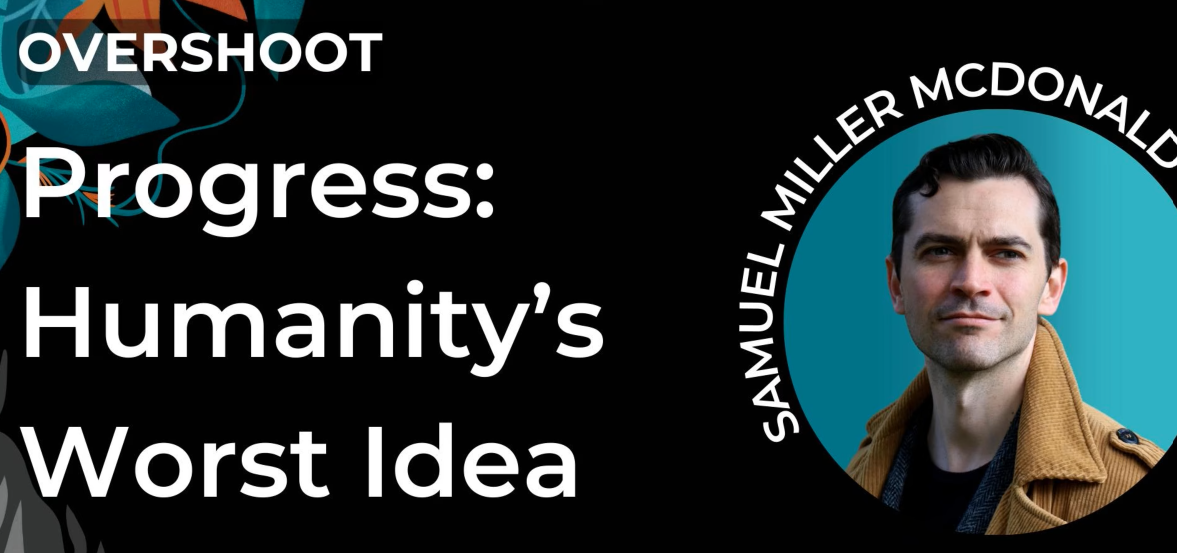
The book, Progress: A History of Humanity’s Worst Idea by geographer Samuel Miller McDonald gives a systematic criticism of the foundational mythology of civilization—which is the idea that human history has been a straight-forward, upward-moving process of moral, material, and technological progress. McDonald maintains that "progress" is not a law of nature or a general good, but rather a hazardous fiction created by imperial, political, and corporate elites in order to justify resource extraction, social stratification, and planetary overshoot.
The Ecological Energy Framework
McDonald uses an ecological framework rooted in energy exchange relationships to evaluate human societies across history:
In historical times egalitarian and long-lived societies had animistic and biophilic worldviews. They functioned within ecological limits by carrying out energy exchanges which either preserved or improved the regional biomes.
Societies that are parasitic—those which are organized on the principle of endless expansion—draw from both the physical and the abstract realms of energy at a rate faster than living systems can renew it, and parasitic societies will inevitably cause social collapse and ecological degradation.
The Three Ages of Parasitism: McDonald traces how parasitic growthism evolved through three historical phases:
The Mythical Age: Ancient agricultural empires which used religious mythology to justify class hierarchies, slave labor, and the exploitation of land.
In The Secular Age the teleology of the Enlightenment and the Industrial Era replaced the idea of divine will with rationalism, industrialization, and imperial expansion.
The Age of Economism: the present-day, global capitalist network driven by fossil fuels, in which market expansion and GDP growth are regarded as the only measures of human success.
The Four Camps of Modern Progress Narratives
The book categorizes contemporary defenses of the progress myth into four distinct ideological groups:
The view known as Techno-Liberal Optimism, which has been promoted by people such as Steven Pinker, asserts that human life is continually getting better by referring to certain statistical figures (for example, increases in GDP or the uptake of consumer technology), even though it fails to take into account biophysical collapse, growing inequality, and ecological debt.
The Android Kingdom of Silicon Valley is a transhumanist, techno-feudal group which considers biological life and the Earth to be disposable hardware and sees the development of artificial intelligence, mind uploading, and colonies on other planets as the next phase in human evolution.
The Social Justice Vanguard: Reformist movements have been taken over by neoliberal structures which concentrate on representation and on achieving institutional inclusion within an extractive growth model rather than removing the fundamental economic engine.
Right-wing opportunists are reactionary populists who take advantage of the fears caused by social and ecological breakdown, presenting authoritarian scapegoating while at the same time protecting the property rights of the elite.
Neoliberal Resilience and Elite Escape Fantasies
McDonald looks into the reason why neoliberalism has remained so resilient even though it has caused extensive ecological and social crises; since it places a priority on market growth rather than on democratic political rights, it absorbs reformist movements and takes advantage of people's tendency to cooperate in order to strengthen corporate power.
When faced with biophysical limits the ruling elite do not give up growthism; rather they turn to fantasies regarding transhumanism, geoengineering and escaping to other planets. McDonald shows that these elite ideas are delusional extensions of parasitic growthism aimed at avoiding biophysical accountability.
Alternative Paths Forward
In order to prevent civilizational collapse, McDonald suggests giving up the myth of progress and adopting an ethic based on biophilia, fairness, and restraint. Among the main aspects of this change are:
Replacing fossil fuel–intensive industrial agriculture with small-scale, restorative farming.
The restoration of natural ecosystems and the maintenance of Indigenous land rights together with their traditional ecological form of stewardship.
Biophysical restraint means enforcing strict bans on fossil fuels, rejecting automated technological solutions such as generative AI, and adopting degrowth principles.
The idea of class struggle being egalitarian involves organizing collective resistance directed at corporate monopolies in order to restore democratic control over the common resources.